
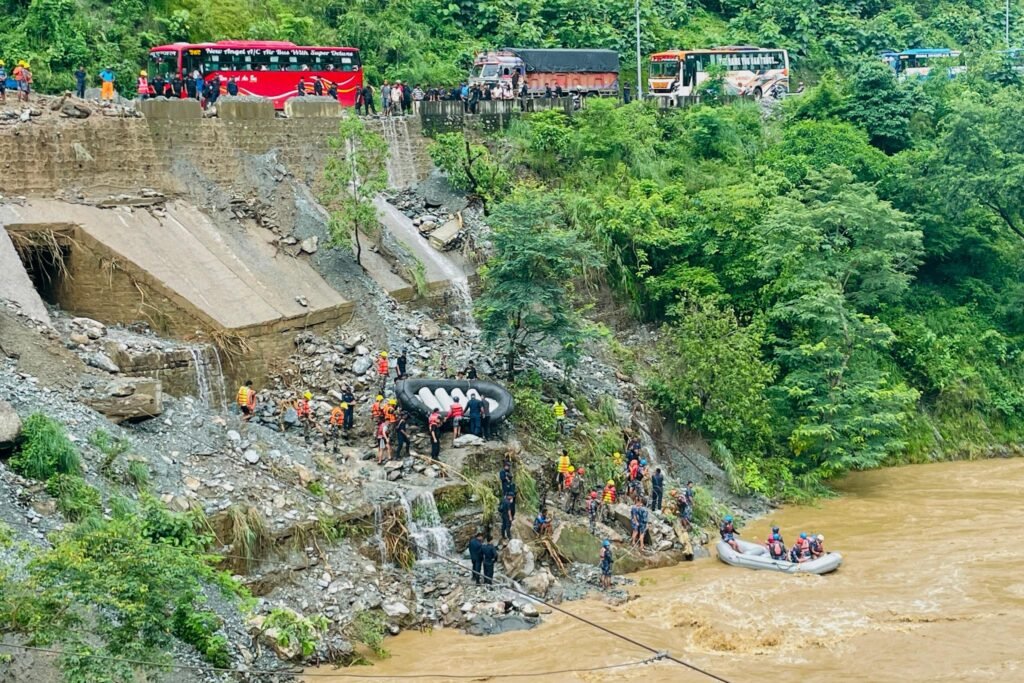
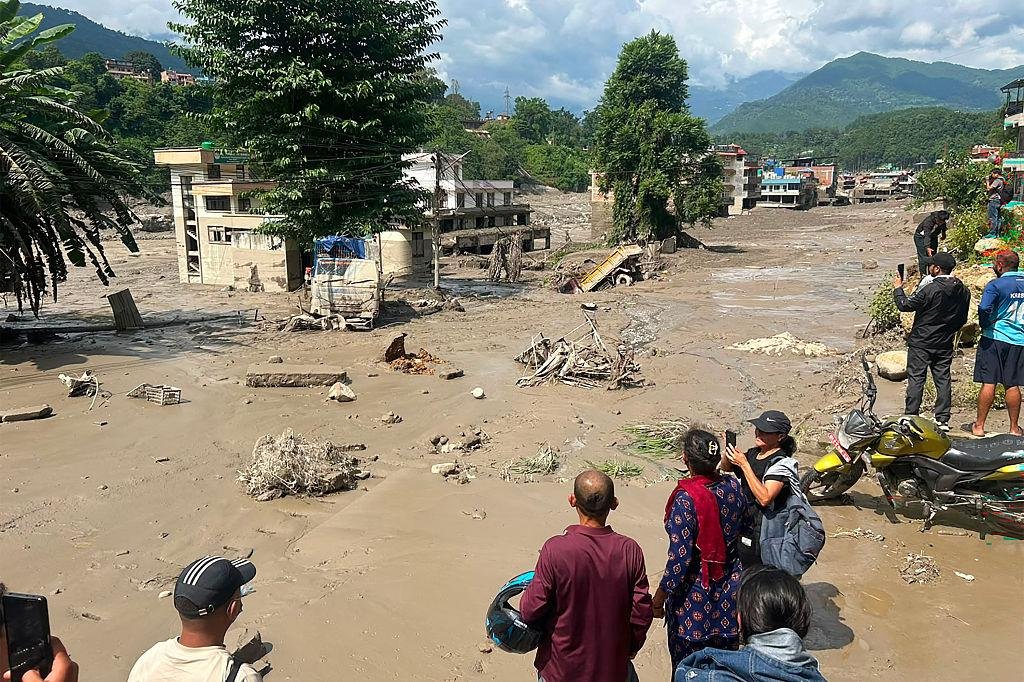
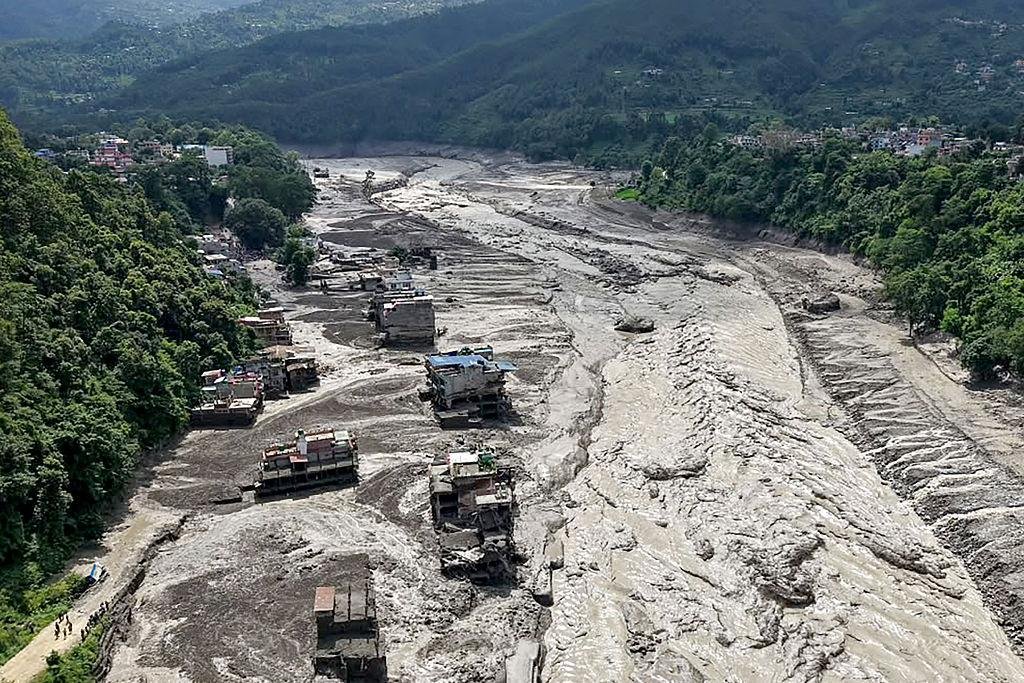
The catastrophic flash flood that struck Nepal on August 26, 2026, has left a trail of destruction across the Himalayan region. The disaster began upstream around the Nepal-Tibet border and sent enormous amounts of water, mud, rock and debris downstream through the river system. Reports indicate that the disaster has caused widespread deaths, missing persons and severe damage to homes, roads, bridges and infrastructure.
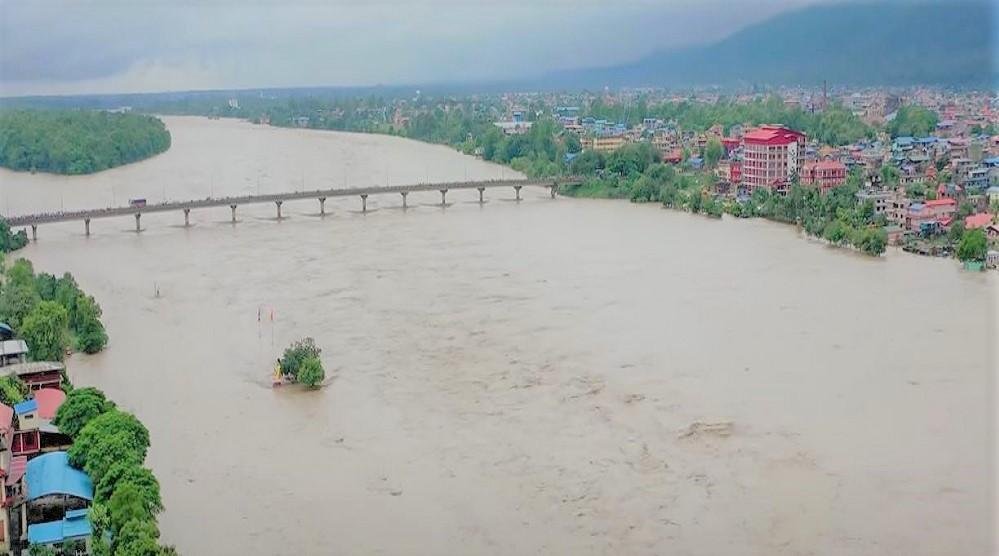
As floodwaters moved downstream through the Trishuli and Narayani rivers, another disturbing scene emerged. People gathered along parts of the river to retrieve objects carried downstream, including gas cylinders and other belongings. Videos circulating online have also prompted allegations that some individuals were taking valuables from victims.
The sight has raised an uncomfortable question:
Why would anyone think about collecting possessions when people are still missing and bodies are being recovered from the same river?
The answer is more complicated than simply saying that everyone involved is greedy or immoral.
What is happening along the Narayani River?
The floodwaters carried an enormous amount of material downstream. Authorities have been recovering bodies from the Trishuli and Narayani rivers.
On August 27, reports said that 64 bodies had been recovered from the Trishuli and Narayani river systems, highlighting the scale of the downstream impact.
At the same time, videos shared online show people attempting to retrieve objects from the powerful river, including gas cylinders. One widely circulated video reportedly shows two people fighting over a gas cylinder that had been swept downstream.
It is important, however, to distinguish between verified recovery of flood debris and unverified social-media claims about people stealing jewelry or belongings from dead victims.
That distinction matters because misinformation can spread extremely quickly during disasters.
Why would people collect things from floodwater?
There isn’t one single explanation.
Different people may be acting for completely different reasons.
Some may be looking for useful necessities
A gas cylinder, for example, has obvious practical value.
If someone’s home has been destroyed and a usable cylinder suddenly appears in the river, they may see it as something that can be recovered and used.
This is different from deliberately taking someone’s jewelry or money.
Recovering potentially useful disaster debris and stealing from a deceased person are not the same behavior.
That distinction should be maintained in any responsible reporting about the incident.
Economic hardship can influence behavior
For someone living with financial insecurity, an object worth several thousand rupees can represent a significant amount of money.
A gas cylinder, metal equipment, electronics or other belongings may therefore be viewed not as someone’s lost property but as an unexpected economic opportunity.
That doesn’t make taking another person’s property right.
But economic pressure can help explain why some people make decisions that would otherwise seem unthinkable.
Disasters temporarily weaken normal social controls
During a major disaster, police, rescue workers, government officials and emergency responders are focused primarily on saving lives.
The normal systems that discourage theft can become stretched.
Research into disaster-related crime has found that looting can occur in some disasters, although the idea that widespread looting is an inevitable part of every disaster is misleading. Researchers have also found substantial differences between disasters and communities.
In other words:
A disaster does not automatically turn ordinary people into criminals.
But the breakdown of normal routines can create opportunities for individuals who are already willing to exploit them.
The psychology of “someone else’s loss is my opportunity”
Perhaps the most disturbing mentality is opportunism.
A person sees something valuable floating in the river.
Instead of thinking:
“Someone may have lost this.”
They think:
“If I don’t take it, someone else will.”
That psychological shift can happen quickly in a crowd.
Once several people begin collecting objects, others may interpret the behavior as socially acceptable.
This creates a bandwagon effect.
One person enters the water.
Another follows.
Then another.
Soon, something that initially looked abnormal begins to appear normal simply because many people are doing it.
But what about jewelry and money belonging to dead victims?
This is where the ethical boundary becomes much clearer.
If someone knowingly removes jewelry, cash, phones or other personal belongings from a deceased victim for their own benefit, that should not be described simply as “scavenging.”
It is exploitation of someone who can no longer protect their property.
The victim may have family members desperately searching for them. Their phone may contain the last photographs of their family. Their identification documents may be essential for identifying the body. Their jewelry may have enormous emotional significance to their relatives.
Therefore, recovering a body or personal belonging should ideally be handled through official rescue, police and identification procedures, rather than private collection.
Why don’t disasters always produce looting?
This is an important point.
It would be wrong to conclude:
“People become selfish during disasters.”
In reality, disasters frequently produce the opposite behavior.
People risk their own lives to:
- rescue strangers
- carry injured people to safety
- search for missing relatives
- distribute food and water
- provide shelter
- transport victims to hospitals
- recover bodies
- help authorities identify victims
Research on disasters has repeatedly challenged the idea that widespread social breakdown and looting are inevitable. In many disasters, cooperation and solidarity are much more common than widespread criminality.
So the people collecting objects from the Narayani should not be treated as representative of everyone affected by the disaster.
There is also a dangerous side to collecting objects from the river
Apart from the ethical question, entering the Narayani to retrieve objects can be extremely dangerous.
The river remains affected by massive volumes of water and debris coming downstream from the disaster zone.
People may see a floating cylinder or other valuable object and think:
“I can grab it.”
But they cannot know what is coming behind it.
Another surge could arrive.
A submerged vehicle could be nearby.
The riverbank could collapse.
A person could be pulled into deeper water.
Authorities have therefore urged people to remain cautious around affected river systems while rescue and recovery operations continue.
The bigger lesson from the Narayani flood
The disturbing videos should not simply become an opportunity to insult people.
Instead, they raise several serious questions about disaster preparedness, public awareness, poverty, law enforcement and social responsibility.
A catastrophic flood creates desperation.
It creates uncertainty.
It separates families from their possessions.
And it can create situations where the boundary between recovering something useful and exploiting someone else’s loss becomes dangerously blurred.
The responsibility of the public is to prioritize human life first.
The responsibility of authorities is to secure affected areas, recover bodies respectfully, identify victims and protect their belongings.
And the responsibility of social media users is to avoid turning unverified videos into accusations against entire communities.
Final thought
The most heartbreaking part of a disaster is not only the destruction of houses, roads and infrastructure.
It is the fact that every object carried away by the river may have belonged to someone who was desperately trying to survive.
A phone may belong to a missing father.
A piece of jewelry may have been a family heirloom.
A bag may contain someone’s documents.
A vehicle may belong to a family whose entire livelihood has disappeared.
The Narayani is carrying more than debris downstream.
It is carrying pieces of people’s lives.
And that is why recovering someone’s belongings should be treated with dignity not as a sudden opportunity to make money.