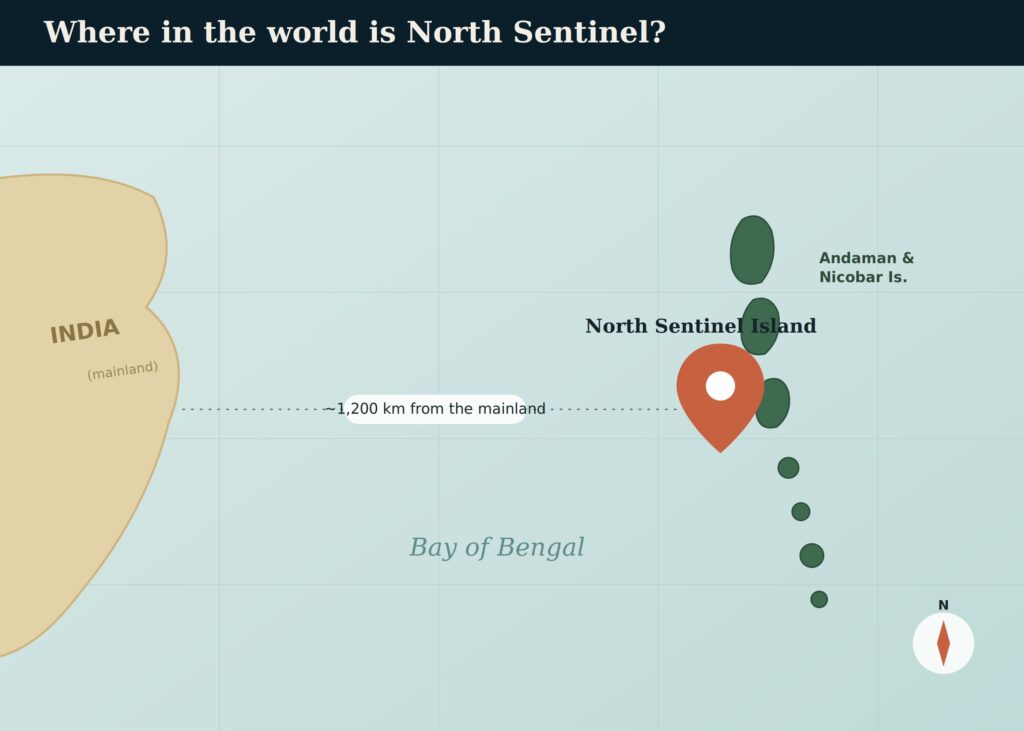
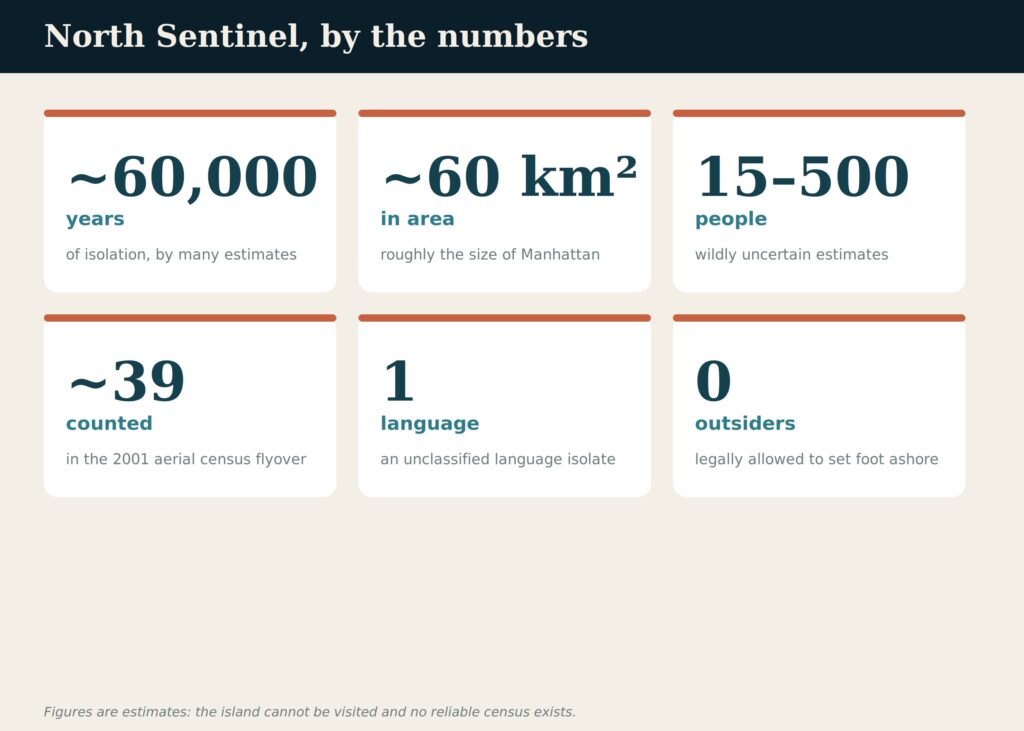
In the warm waters of the Bay of Bengal, roughly 750 miles from the Indian mainland and tucked into the western edge of the Andaman archipelago, lies a densely forested island about the size of Manhattan. It has no roads, no ports, and no modern infrastructure of any kind.
On most maps, it is just a green smudge ringed by a coral reef. Yet North Sentinel Island is one of the most fiercely guarded places on Earth, not by armies or fences, but by the people who live there and by a government that has decided the most powerful thing it can do is stay away.
The island is home to the Sentinelese, widely regarded as one of the last truly uncontacted peoples on the planet. They have rejected the outside world for as long as anyone has tried to reach them, and India has responded with a policy almost unique in the modern world: it has drawn a line around the island and forbidden everyone, including its own citizens, from crossing it.
Table of Contents
“Cannot enter” — what that really means
The headline framing is striking, and it is worth being precise about it. India holds full sovereignty over North Sentinel; legally, it is Indian territory. The point is not that the state lacks the authority to land there, but that it has chosen, deliberately and for decades, not to and that it bars everyone else from doing so as well.
That choice is written into law. The Andaman and Nicobar Islands (Protection of Aboriginal Tribes) Regulation of 1956 designates North Sentinel as a tribal reserve and makes it illegal for any Indian citizen or foreign national to travel there.
Around the island sits an exclusion zone commonly described as roughly five kilometres that the Indian Navy and Coast Guard patrol. Additional protections come from the Indian Forest Act of 1927, the Wildlife (Protection) Act of 1972, and the Scheduled Castes and Scheduled Tribes (Prevention of Atrocities) Act of 1989. The Sentinelese are classified as a Particularly Vulnerable Tribal Group, the most protected category India recognizes.
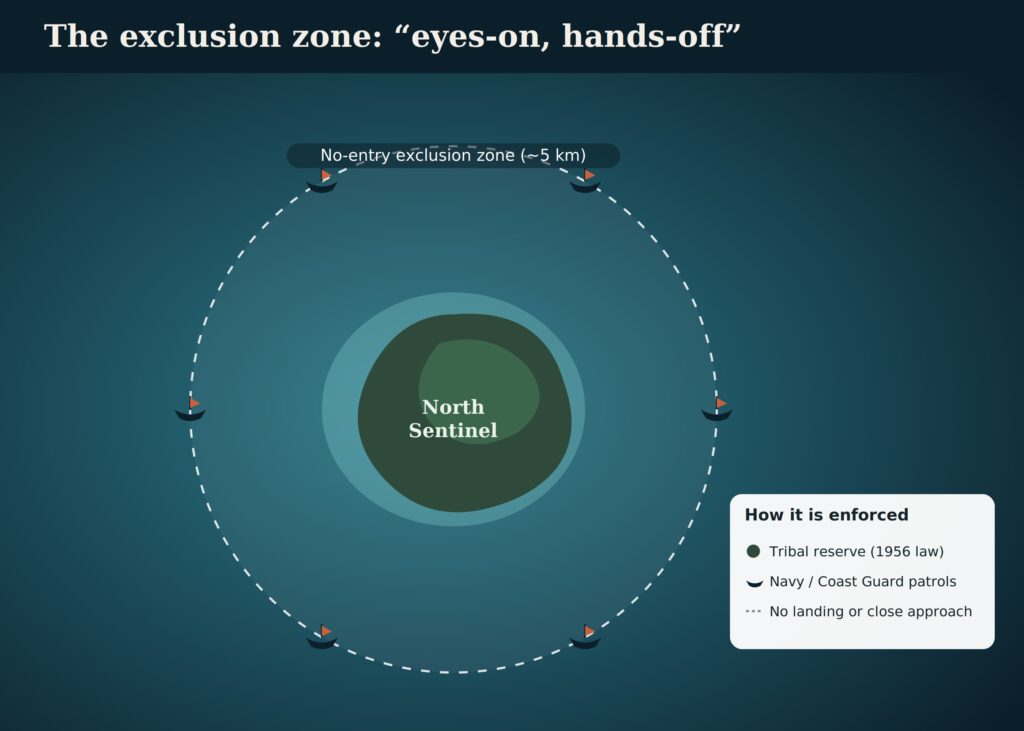
Officials describe the approach as “eyes-on, hands-off”: the authorities monitor the island from a distance to confirm the population is alive and well, but make no attempt to land, photograph up close, or initiate contact. The government will not even recover the bodies of outsiders killed on the island, partly to avoid the risk of carrying disease ashore. In practice, this makes North Sentinel a place the Indian state watches over but will not set foot on.
Who are the Sentinelese?
The Sentinelese are hunter-gatherers who fish, hunt wild boar, gather plants and fruit, and harvest crabs. They build narrow canoes that they pole through the shallow lagoon, though these vessels are not built to cross the open ocean. They make and use bows, arrows, and spears with notable skill, most famously aimed at anyone who approaches their shore.
No one knows how many of them there are. Because researchers cannot land or conduct a proper census, every figure is an educated guess based on aerial surveys and distant observation. Estimates have ranged from as few as 15 to as many as 500; a 2001 Indian census exercise, based only on a helicopter flyover, produced a rough figure around 39, while the advocacy organisation Survival International has described a community of perhaps 50 to 200 people.
Their language is unclassified so distinct that even members of the neighbouring Onge tribe, the people thought to be closest to them, reportedly cannot understand it. This linguistic isolation hints at just how long the Sentinelese have been on their own.
A 60,000-year story
Anthropologists believe the Sentinelese are descendants of some of the earliest human populations to leave Africa, migrating eastward along the coast of Asia tens of thousands of years ago. Many researchers estimate their ancestors may have inhabited North Sentinel for as long as 60,000 years, which would make them one of the oldest continuously isolated human communities in existence.
Studying their origins directly is essentially impossible, so most of what is inferred comes from genetic and cultural studies of related Andamanese groups rather than from the Sentinelese themselves.
What that long isolation means in practical terms is sobering: the Sentinelese have had almost no exposure to the pathogens that the rest of humanity has lived alongside for millennia. They likely have little or no immunity to common illnesses such as influenza, measles, or even the common cold. A single visitor carrying an ordinary virus could, in theory, trigger an epidemic capable of devastating the entire population. This is the core reason the no-contact policy exists and it is not hypothetical.
The cautionary history of contact
The danger is grounded in what happened to the other indigenous peoples of the Andamans. The Great Andamanese, the Onge, and the Jarawa were once similarly isolated. After sustained contact with outsiders, all suffered catastrophic population collapses driven by introduced diseases such as measles and influenza, alongside land encroachment and exploitation.
Colonial-era Andamanese numbers are estimated to have fallen from several thousand in the mid-1800s to a few hundred within decades. The Sentinelese are, in a sense, the group that avoided that fate by refusing to participate.
Their hostility, often portrayed as mysterious savagery, has a traceable history. The first documented landing came in 1880, when the British naval officer Maurice Vidal Portman then administering the Andaman penal colony led an armed expedition onto the island.
Most inhabitants fled, but his party captured an elderly couple and four children and took them to Port Blair. The two adults sickened and died quickly, almost certainly from diseases to which they had no immunity. The children were eventually returned with gifts, likely carrying foreign germs back with them.
Portman himself later acknowledged that contact with outsiders had brought the Andamanese “nothing but harm.” It is entirely plausible that the trauma and disease of that single episode helped harden Sentinelese hostility toward all visitors for generations.
Earlier sightings reach back further a 1771 East India Company survey vessel noted lights on the shore, and there are older, unreliable secondhand accounts but Portman’s kidnapping stands as the first significant, and disastrous, direct contact.
The one moment of peace
There is a remarkable exception to the long record of arrows and bloodshed. From 1967 onward, the Indian anthropologist T.N. Pandit and colleagues from the Anthropological Survey of India made repeated, patient “gift-dropping” expeditions, leaving coconuts, bananas, pots, and iron tools on the beach and then withdrawing to observe from a safe distance. For years the Sentinelese hid, watched warily, or fired arrows.
The breakthrough came on 4 January 1991. A team that included the anthropologist Madhumala Chattopadhyay tried something new: instead of dumping a sack of coconuts, they rolled them one at a time into the water toward the islanders, who began treating it almost like a game. Tribesmen waded out, came close to the boat, and accepted coconuts directly from human hands. Photographs of that encounter visitors standing neck-deep in water passing gifts to unarmed Sentinelese men circulated widely and reshaped how the public saw the tribe.
Pandit, who spent decades observing them, has pushed back on their fearsome reputation, describing the Sentinelese as essentially peace-loving people who threaten outsiders to defend their territory but, in his experience, stepped back rather than escalating to lethal violence when his teams retreated. Those friendly contacts, however, were never built upon. India ultimately concluded that the safest and most respectful course was to stop trying altogether, and organised contact expeditions ended.
When the world came too close
Several episodes since have tested the island’s isolation and underscored why the policy holds:
The 2004 Indian Ocean tsunami devastated the wider Andaman and Nicobar region, and there were fears the low-lying island had been swamped. When an Indian Coast Guard helicopter flew over to check, a lone Sentinelese man emerged onto the beach and fired an arrow up at the aircraft. The message the same one the tribe had been sending for millennia was unmistakable: they had survived, and they wanted to be left alone.
In January 2006, two Indian fishermen, Sunder Raj and Pandit Tiwari, were fishing illegally near the island. By most accounts they had been drinking and fell asleep; their anchor gave way and the boat drifted ashore. They were killed by the Sentinelese and buried on the beach. A helicopter sent to recover the bodies was driven back by arrows, and the remains were never retrieved. Notably, the father of one of the dead men later argued that the islanders should not be blamed and should be left in peace.
The most internationally publicised incident came in November 2018, when John Allen Chau, a young American who described the island in his journal as a stronghold of evil he intended to convert to Christianity, paid fishermen to ferry him near the shore. He made repeated attempts to land, singing and offering gifts, and was driven off before being killed on a later approach. Indian authorities, mindful of the 2006 precedent and of the disease risk, ultimately did not attempt to recover his body. Advocacy groups argued the tragedy should never have happened and that the Sentinelese had, yet again, clearly expressed their wish to be left alone.
In March 2025, an American social-media influencer, Mykhailo Polyakov, illegally landed on the island for a few minutes, reportedly leaving a can of soft drink and a coconut as “offerings” before being spotted and arrested. He apparently did not encounter any Sentinelese but observers noted that even his brief, attention-seeking visit could, in the worst case, have introduced a pathogen capable of wiping out the entire population.
The deeper debate
North Sentinel forces uncomfortable questions that have no easy answers. Is it ethical to leave a community in isolation when modern medicine and aid could, in principle, help them? Or is the only genuinely respectful choice to honour the consistent, unmistakable wish of a people who have rejected the outside world at every opportunity?
The prevailing view among the Indian government and tribal-rights advocates is clear: the Sentinelese appear healthy and self-sufficient, they have repeatedly signalled that they want no contact, and the historical record shows that contact has overwhelmingly brought disease, exploitation, and death to isolated peoples. Under that logic, the most humane and responsible policy is precisely the hands-off stance India has adopted protecting outsiders from being killed, and protecting the Sentinelese from a far quieter but more total catastrophe.
Critics and the merely curious will keep being drawn to the island’s mystery, and some will keep trying to reach it. But North Sentinel endures as something genuinely rare in a mapped, surveilled, and hyper-connected world: a place that has seen our civilization arrive at its shore again and again, and has chosen, every single time, to send it back. The most powerful protection it has is not the law or the patrol boats, but a simple and consistent answer to everyone who approaches an answer the rest of the world has slowly learned to respect.
Selected sources
- Encyclopaedia Britannica, “Why Is It Illegal to Visit North Sentinel Island in India?”
- Survival International, “Sentinelese” peoples profile
- Nature (Humanities and Social Sciences Communications), anthropological study of Sentinelese contact, 2024
- BBC and CBS News interviews with anthropologist T.N. Pandit, 2018
- NBC News and the Associated Press are reporting on the 2004 tsunami and the 2018 Chau killing
- CNN/AOL reporting on the 2025 Polyakov arrest
- IFLScience and Wikipedia on Maurice Vidal Portman and the 1880 expedition
- EBSCO Research Starters and WorldAtlas on the Sentinelese history and population estimates
Note: Because the island cannot be visited and no reliable census exists, population figures and some historical details are necessarily estimates drawn from distant observation and secondary accounts.
Read Related Blogs
The Science of Addiction: The Hidden War on Your Brain
The Alive Cannot Go, the Dead Cannot Tell: Who Discovered Heaven and Hell?