
Behind every scroll, swipe, and notification lies a decades-long scientific enterprise one that has quietly turned the human reward system into a billion-dollar commodity.
Dopamine was never meant for this
Think back to the last time you unlocked your phone without quite meaning to. You were mid-conversation, or eating, or lying in bed trying to sleep, and yet your thumb moved on its own. That moment is not a personal failure. It is a designed outcome.
At the center of the story is dopamine, one of the most misunderstood chemicals in neuroscience. Popular culture calls it the “pleasure chemical.” That is only half-right. More precisely, dopamine is the brain’s anticipation signal. It surges not when a reward arrives, but when the brain predicts one might. It is the neurological engine of seeking behavior, the force that once drove our ancestors to follow animal tracks, to climb a ridge to see what lay beyond.
That same force now fires every time your phone buzzes.
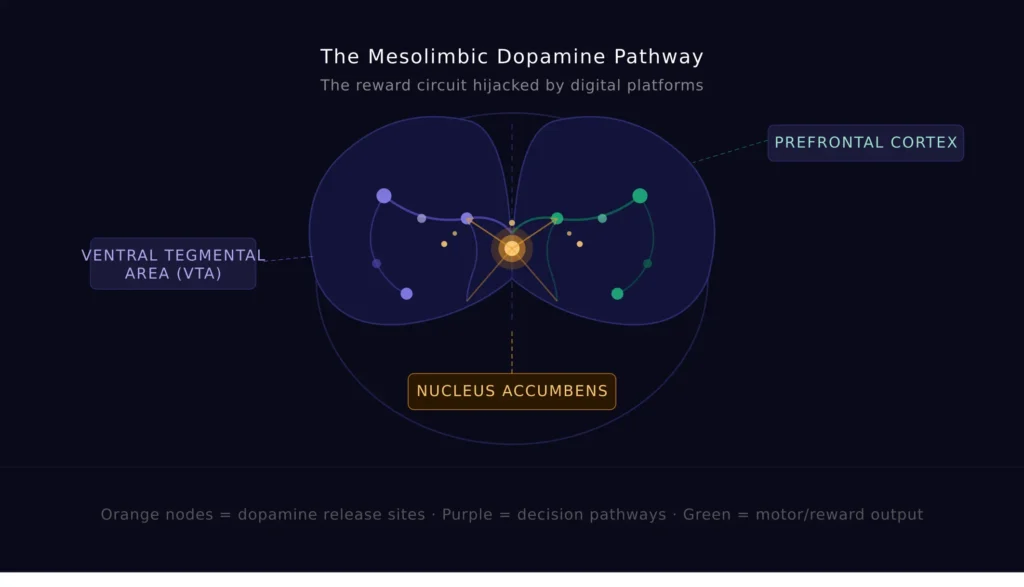
The mesolimbic dopamine pathway connecting the ventral tegmental area, nucleus accumbens, and prefrontal cortex evolved over millions of years to motivate survival behaviors. It was never designed to handle 200 notifications a day.
Research published in peer-reviewed neuroscience journals confirms what many have long suspected: frequent social media engagement measurably alters dopamine pathways, fostering a dependency pattern that closely mirrors what addiction medicine sees with substance use disorders. Brain imaging studies show corresponding changes in the prefrontal cortex and amygdala regions governing decision-making and emotional regulation respectively.
Why uncertainty is more addictive than reward?
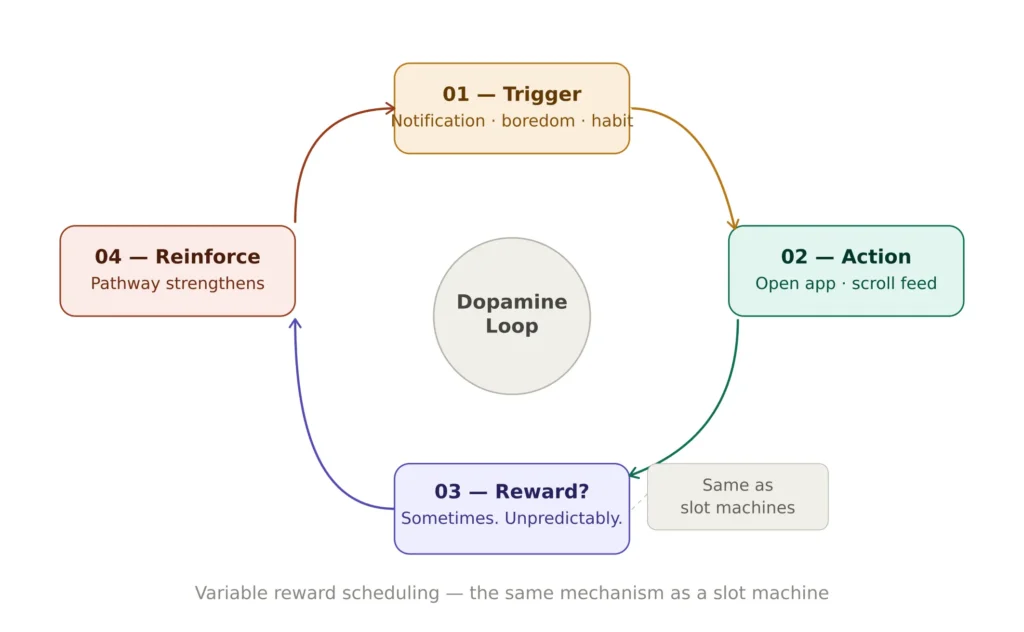
The dopamine loop would be powerful enough on its own. But the engineers who built modern social platforms discovered something more potent: variable rewards.
The principle comes from behavioral psychology. B.F. Skinner found in the 1950s that animals press levers far more obsessively when rewards come unpredictably not on every press, not on a fixed schedule, but at random intervals. The same mechanism is the backbone of slot machines. And it is, by design, the backbone of the social media feed.
A 2024 study in peer-reviewed literature found that variable reward systems specifically the uncertainty of receiving likes, shares, or comments are deliberately incorporated into platform design to maximize compulsive checking. Over time, users develop the same intense craving for continuation that is the hallmark of behavioral addiction.
The algorithm that knows you better than your friends
What separates modern digital addiction from older compulsive behaviors is a third actor: artificial intelligence. The algorithm does not just present content. It learns, at an individual level, exactly what will keep you watching.
Every interaction you make generates data points what you watched, how long, where you paused, what you skipped, when your scroll slowed. Machine learning systems process billions of these data points across all users simultaneously. The result is a behavioral model of you that is frighteningly accurate one that can predict your emotional state, your likely reactions, and the specific type of content most likely to hold your attention at any given moment.
“Just as the hypodermic needle is the delivery mechanism for drugs like heroin, the smartphone is the modern-day hypodermic needle, delivering digital dopamine for a wired generation.” Anna Lembke, Director of Addiction Medicine, Stanford University
The algorithm is not asking “what would this person enjoy?” It is asking a narrower, more powerful question: what will keep this person engaged the longest? Those are not always the same thing. Research on algorithmic feeds shows that emotionally provocative content outrage, anxiety, tribalism outperforms neutral content on nearly every engagement metric. Platforms do not program anger. They simply reward it, and the algorithm learns.
The features designed to remove your exit points
Modern apps are not random collections of features. They are behavioral environments, engineered using decades of psychology and neuroscience research. The following techniques represent the most consequential design choices behind digital habit formation:
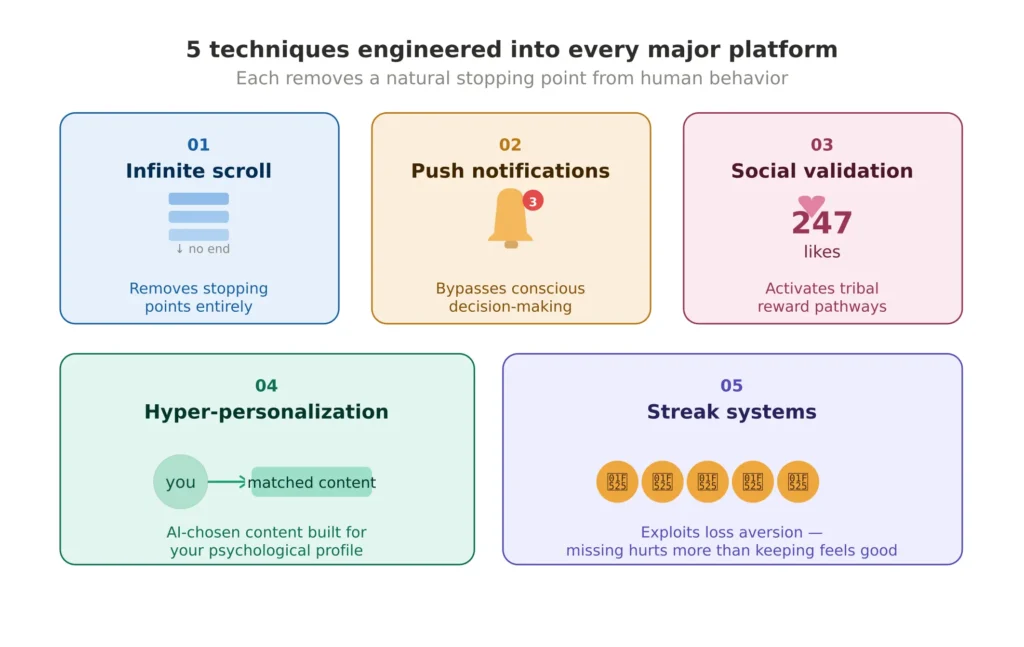
Infinite scroll
Deliberately eliminates natural stopping points. Before its invention, content had pages built-in moments of decision. Infinite scroll removes them entirely, shifting from opt-in to opt-out.
Push notifications
External triggers that bypass conscious decision-making. The vibration or sound alone triggers a conditioned dopamine anticipation response before you have even seen the screen.
Social validation metrics
Likes, shares, and follower counts activate the brain’s social reward pathways the same regions that evolved to track our standing within a tribe. A Harvard study found self-disclosure on social platforms activates the same brain regions as addictive substances.
Hyper-personalization
Content is not chosen by you it is chosen for you, optimized by AI to match your specific psychological profile. The feed you see is designed for maximum retention, not maximum value.
Streak and reward systems
Daily login rewards and streak counters exploit loss aversion the psychological tendency to feel losses more acutely than gains. Missing a streak feels worse than maintaining it feels good.
What the data actually shows?
The numbers are not theoretical. A 2025 study across teens and young adults found that 60% of respondents believe they are addicted to their phones, and 93.8% reported experiencing at least one of the following: depression, anxiety, low self-esteem, body image issues, sleep problems, social isolation, or emotional difficulties.
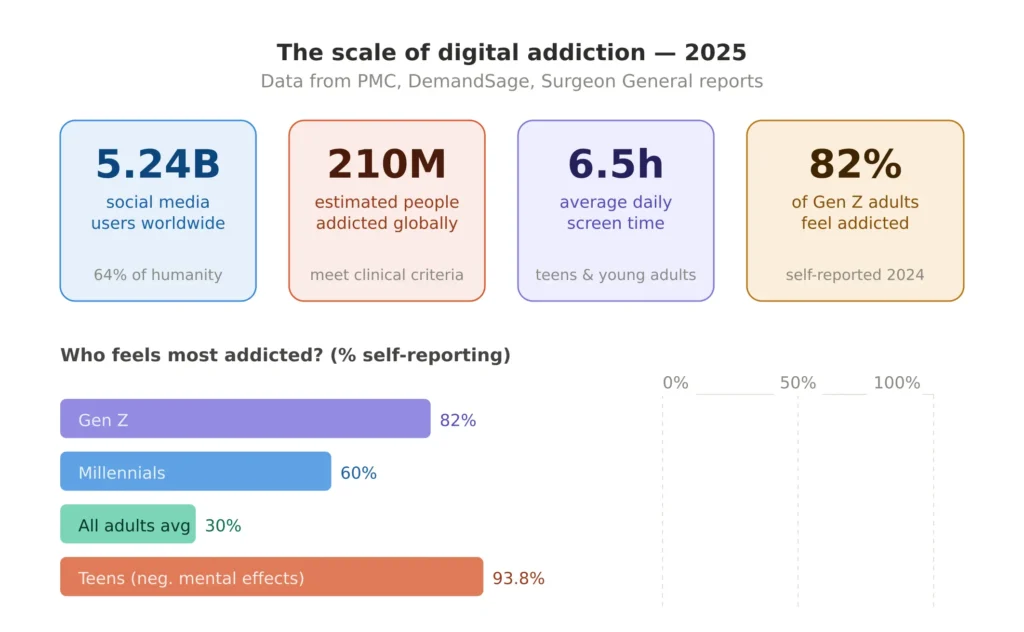
Over 30% of American adults say they feel addicted to social media. Among college students, that figure rises above 60%. Globally, an estimated 210 million people now meet behavioral criteria for social media or internet addiction. In 2024, the U.S. Surgeon General called on Congress to add health warnings to social media platforms language not unlike the warnings on cigarette packaging.
Users who spend 3 or more hours daily on social media are significantly more likely to report negative feelings about their social well-being, per Lululemon’s Global Wellbeing Survey. Experts consider 3+ hours per day as a threshold for “heavy use.”
You are not the user. You are the product.
Understanding why platforms are built this way requires understanding their business model. These companies do not sell social connection. They sell attention specifically, your attention to advertisers. Every additional minute you spend on a platform translates directly into advertising revenue.
This is what economists call the attention economy: a system where human focus is the scarce resource being bought and sold. The longer a platform holds your gaze, the more it earns. There is no financial incentive to make you feel better or put the phone down. There is every incentive to keep you scrolling.
This is not a design flaw. It is the design
Reclaiming the prefrontal cortex
The brain is not a fixed object. Neuroplasticity the brain’s capacity to rewire itself through repeated behavior — works in both directions. The same mechanism that built the habit can rebuild it. Behavioral research points to several evidence-supported strategies:
Notification surgery
Turn off all non-essential notifications. This removes the primary external trigger and forces conscious engagement rather than conditioned response.
Scheduled access windows
Set specific times for checking social media rather than allowing ambient, always-on access. The habit becomes deliberate rather than automatic.
Physical friction
Keep your phone in another room during meals and before sleep. Physical distance is more effective than willpower for breaking conditioned reflexes.
Metacognitive awareness
Simply knowing how the loop works changes your relationship with it. The moment you recognize the trigger-action-reward cycle in real time, the automaticity weakens.
While individual strategies matter, researchers and ethicists are increasingly asking whether the burden of defense should fall on users at all. Current algorithmic systems are optimized for engagement metrics, not wellbeing. Whether that can or should change is one of the defining regulatory debates of this decade.
We are living through one of the largest uncontrolled behavioral experiments in human history. The technology is extraordinary. The intentions of many who built it were genuine. But the incentive structures that govern it reward one thing above all else not connection, not joy, not information but the length of time your eyes stay on the screen. The question for the next decade is not whether the algorithm shapes human behavior. It does. The question is whether the humans who build it will choose to care about what it shapes us into.
Sources: PMC / De et al. (2025) Social Media Algorithms and Teen Addiction; PMC / Amirthalingam et al. (2024) Understanding Social Media Addiction; Gashaj (2025), Undergraduate Journal of Public Health; DemandSage Social Media Addiction Statistics (2025); AddictionHelp.com; BrandWell; Sokolove Law; Influencer Marketing Hub; Anna Lembke, Stanford University School of Medicine.
Suggested Read:
The Alive Cannot Go, the Dead Cannot Tell: Who Discovered Heaven and Hell?